Dr. Joan Cartwright is the founder and director of Women in Jazz South Florida, Inc. After touring as a Jazz and Blues vocalist and songwriter, Cartwright realized that she had worked with only six women musicians out of hundreds she performed with in the U.S., Europe, Mexico, Africa, and the Caribbean. In 2007, she set out to find women instrumentalists and recruit them to their nonprofit organization that promotes women musicians, globally.
In 16 years, Joan recruited 433 members with 276 musicians and 77 men who support the organization’s mission. She produced eight CDs of women’s compositions, proving that many women create original music. “My mission is to raise consciousness about the marginalization of women musicians in the 80% male-dominated music industry,” Cartwright explained.
Her doctoral dissertation, Women in Jazz: Music Publishing and Marketing, explored women in jazz and their earnings as music publishers. Joan examined the business practices of 20 women musicians in the U.S., between 30 and 64, who composed and published music. The variables were education, number of songs, publishing company, affiliation (ASCAP or BMI), and how they used marketing, branding, promotion, and advertisement. Also, used was data from Joan’s 250 interviews with women composers on BlogTalkRadio, since 2008.
The participants discussed their challenges with gender and age discrimination. The focus was on business tactics for branding and marketing that affected the professional careers of women jazz musicians. Joan identified six best business practices for women in jazz and guidelines for young women entering the industry.
Additionally, suggestions were made for ways that private corporations and government entities could be more inclusive of women’s music, through programming and grants. Joan outlined recommendations for future research and policy for the equitable treatment of women musicians, particularly in media and film music.
Global value of music copyright grew 14% to $41.5bn in 2022. Author and former Spotify chief economist Will Page has published his annual analysis of the global value of music copyright.
According to the 2021 Report on Global Music, copyright value grew 18% to $39.6bn. This amount was $21bn in 2017. Historically, women earned less than 20% of the earnings from music production for two reasons:
- Gender discrimination in corporate control, public funding, and the music marketplace
- The lack of business acumen among women musicians
Cartwright insisted that, “Just 5% of $40bn, that is $2 Billion, would help women musicians, fantastically! Our organization has a plan to build the Musicwoman Archive and Cultural Center in Clarendon, North Carolina,” a $400 million complex with a 300-seat theater, recording studio, rooms for workshops, clinics, and practice, a 40-room hotel with a state-of-the-art commercial kitchen to serve seven restaurants because what goes with music better than food?
Also, on the grounds will be a 40-room dormitory for post-graduate students to live and research women musicians to write papers and books about them, and to digitally catalog their music scores, lead sheets, recordings, photographs, books, films, and other memorabilia.
In fulfillment of their mission, WIJSF publishes two magazines, annually. Since 2019, they published four Musicwoman Magazines and three Musicman Magazines, since 2020. The new issues, featuring Singers and Horns, are scheduled to publish on June 15, 2023.
Women’s music is featured less at festivals, in streaming media, and on television, radio, and in films. Also, fewer funding opportunities are applied for by women musicians. The major reasons is the lack of nurturing by families and music teachers for girls to become musicians and the lack of knowledge about grants for the arts, or the lack of willpower and skill to submit grant proposals. These are barriers to women being funded to produce and perform their music in public settings.
It is high time and paramount for girls to see role models in music. Many women have emerged as proficient players, in the past two decades. But there is lots of room at the top of the musical chain for women to take a seat.
In most music festivals with 16 to 20 acts, there may be two women headlining. In 2002 and 2007, Björk was the first female headliner at Coachella, attended by millions. In 2006, Madonna performed but not as a headliner. Rihanna and Beyonce performed there in 2006, 2012, and 2018, but not as headliners. In 2017, Lady Gaga ruled the stage, and Beyonce wore it out in a 2-hour show in 2018, proving that the audience loves women in music.
In the world of Jazz, the presence of women is fleeting. But several women emerged on trumpet, saxophone, bass, and drums, instruments allocated to men, traditionally. Most often, women are at the piano, or at the microphone, singing or playing flute. Three drummers garnered the spotlight – Sheila E, Terri Lyne Carrington, and Cindy Blackman Santana. Few bassists have been recognized. There is Kim Clarke in New York, Marion Hayden in Detroit, and Nedra Wheeler in Los Angeles. Of course, Esperanza Spaulding reigns from Portland, Oregon.
The questions remain, when will women’s music be included in the programs of symphonic orchestras and big bands? Who chooses the music for major performances? Is the music industry still a good-ole-boy club, or are women being included in the musical mix?
Cartwright remains doubtful, “Music is powerful, and men tend to hold the reins of power tightly! We may have to wrench that power away from them at some point to enable the messages in women’s music to seep out into the public forum.”
Another book Joan wrote, entitled Blues Women: The First Civil Rights Workers, highlights the music and stories of women who sang the blues to express their sense of freedom in post-slavery America. The quest to lift women musicians up and free their music into the world continues!
Contact: wijsf@yahoo.com, 954-740-3398
Support women musicians at www.wijsf.org
Links:
- 2021 Report on Global Music
- Report: global music copyright value grew 18% to $39.6bn in 2021
- Musicwoman and Musicman Magazines
- Joan’s dissertation: Women in Jazz: Music Publishing and Marketing
- Blues Women The First Civil Rights Workers
- Joan’s lecture at Norton Museum
How Women In The 1920s Defined Jazz
By Imogen Reed
We’re all familiar with the great band leaders of the 1920s, men like Fletcher Henderson, Paul Whiteman and Ace Brigode – all great exponents of the music they so passionately loved. They’re always associated as defining jazz and the dance music of the time – making it popular and bringing it to the masses. They did, and there’s no denying it. Very often, however, the achievement of women – and women of color in the field of jazz during that period is overlooked.
Three Overlooked Greats
A triumvirate of singers were performing at this time that are among the greatest exponents of Jazz and Blues but are largely neglected these days. They are Ethel Waters, Bessie Smith and Alberta Hunter. All born within two years of each other – Smith in 1894, Hunter in 1895 and Waters in 1896. Smith and Hunter were both born in Tennessee while Waters was born in Pennsylvania. What defines all three women is the hardships and incredible suffering they endured in their early lives and how they turned these situations around to gain success in a decade of such developments.
Bessie Smith
 By the time Bessie was nine she was orphaned – her Father had died when she was a baby and her Mother and brother died in the following years. She was taken care of by an older sibling – money and food were scarce and Bessie had to find a way to contribute to the family pot and earn some money. She, along with another brother began busking to earn a crust, travelling (they probably wouldn’t even have had enough money for a bicycle to get there, let alone bicycle insurance) to stand outside The White Elephant Saloon to perform in what was the very centre of the African-American Community there. In 1912, probably around the age of eighteen or twenty – Bessie found her way into working in the chorus lines of various shows, her talent was recognised and she was signed to an initial deal with Columbia records. Here she is singing one of her first recorded pieces – “Baby Won’t You Please Come Home”
Bessie Smith – Baby Won’t You Please Come Home
Bessie had the sort of voice that could only have come from someone who had suffered hardship in their life – the kind of lilting, full sound that comes from deep inside the pit of her stomach. A plaintive, pleading kind of cry that is capable of setting off all sorts of emotions within the listener. Her major works were indeed with the great band leaders of the time including the aforementioned Fletcher Henderson. All in all, she made over 160 recordings for Columbia records – though at the time of her death in 1937, while still working in the theatre and performing, she’d largely been forgotten.
Alberta Hunter
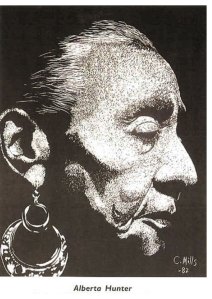 Alberta Hunter knew she could sing and needed the owners of clubs to hear her, so she could prove her talent. During the day she did menial jobs – peeling and scrubbing potatoes, anything to earn a little money, so that at night she could go and look for singing work. Her persistence paid off when she was taken on at a place called the Dreamland Ballroom in 1917; she stayed there for five years.
Alberta Hunter – Fine and Mellow
During the 1920s she recorded for many labels prolifically and regularly, this song from that era is a fine example of the breadth of her talent. In comparison to Smith’s voice – there is more clarity to her vocal, a more soulful sound in a way, that’s not to detract from Smith at all, it just shows how there can be distinct differences between the singers from the era that show how different performers interpret a song.
Hunter had a long life – living to the age of eighty nine. She also took the really unusual step of halting her singing career during the 1950s and retraining to become a nurse – but was tempted out of her retirement to record new tracks even into the 1970s.
Ethel Waters
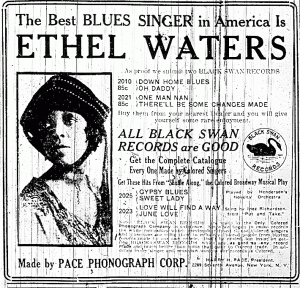 Water’s story is probably the most heartbreaking, brought into the world as a result of a horrific sexual attack on her mother and finding her self married at the incredibly young age of thirteen, Waters showed considerable personal strength in all that she achieved – because of the life she’d lead and the things she’d been exposed to, her talent developed accordingly and she took on and used a number of different styles in performances and recording. She worked alongside Bessie Smith at the start of her singing career – but there was initial needle between the two and Smith did not want Waters to sing blues alongside her. In New York by the early 1920s she was a superstar in theatrical revues for people of color; and by the early 1930’s was the most popular, highest paid woman of color in show business. Waters was first to break the tradition of largely all white casts on Broadway in 1933 by appearing in the all-white show, “As Thousands Cheer”.
Ethel Waters – I’ve Found A New Baby
In this song, recorded in 1925 Water’s shows her estimable talent – with a clear, incisive vocal and one the uses traditional jazz intonation (she was, in fact one of the first singers to use the “proper” jazz intonation when she sang).
Despite all this success and everything she had done, by the 1950s her career faded and she lived out her last years in ill health.
Why Remember These Women?
Without these women singers the face of Jazz would have been immeasurably worse off. Without them, and the strides they made to succeed against all the odds to create the music they loved, there might not be any music scene for people of color at all today. The sort of sounds they created could only come from the kind of people who had seen and lived life in all its (un) glory. Their experiences and their life stories color the sound they made and the songs they sang. It’s impossible not to listen to any of the songs they sang and feel some sort of emotion – and during an era of immense social change and progression that’s a remarkable thing.
____________________________________________________________
Conscious Inclusion of Women Musicians
Joan Cartwright, M.A., Executive Director
Women in Jazz South Florida, Inc.
info@wijsf.org | www.wijsf.org
Copyright 2011 Joan Cartwright
Music, the sound of the spheres, begins in the womb! ~ Diva JC
People first experience music is in the womb. The sound of blood rushing through the mother’s veins is like the sound of strings. The heartbeat is the drum, while mother is singing and humming. But out of the womb, women instrumentalists are omitted, particularly in Jazz. Women are employed by symphonic orchestras on strings and woodwinds but few are in big bands. For decades, big bands neglected to engage women, except for singers and the occasional pianist. Sarah Vaughn worked in Billy Eckstein’s band and Marylou Williams arranged for Duke Ellington and worked with the Mighty Clouds of Joy.
The Lincoln Center Big Band led by Wynton Marsalis has no women. The Carnegie Hall Big Band led by Jon Faddis is defunct but only one woman performed in that band, trombonist Janice Robinson, who performed and recorded with Dizzy Gillespie, Billy Taylor, Marian McPartland, Thad Jones/ Mel Lewis, Slide Hampton, The Jazzmobile All Star Big Band, Gil Evans, McCoy Tyner, George Gruntz and Mercer Ellington. Her seat was not filled by another woman, when she became pregnant.
 Trombonist Melba Liston led a 16-piece all-female band in the 1970s. She was an important jazz arranger in a field dominated by men. She recorded with classmate Dexter Gordon in 1947. When Gerald Wilson disbanded his orchestra on the east coast, Melba joined Gillespie’s big band. She toured with Billie Holiday in 1949, but disliked the rigors of touring. She took a clerical job, supplementing her income as an extra inHollywood, where she appeared in “The Prodigal” and “The Ten Commandments.”
Liston toured with Gillespie for the U.S. State Department to Europe, the Middle East andLatin Americain 1956 and 1957, and her best known solo is recorded on Gillespie’s “Cool Breeze” at Newport Jazz Festival. She formed an all-women quintet in 1958, and touredEuropewith the theatre production “Free and Easy” in 1959, then worked with the show’s musical director, Quincy Jones. In the 1960s, Liston worked with Milt Jackson and Johnny Griffin, and began her long association with pianist Randy Weston. For four decades, Liston arranged and performed Weston, whose song “Mischievous Lady” was composed for her. In 1973, she taught in theWest Indiesat the Jamaica School of Music. Upon her return in 1979, she formed Melba Liston and Company.

Kim Clarke (bass) and Kit McClure (sax)
Tenor saxophonist Kit McClure led a 19-member band but few venues could pay a big band. Her five-piece ensemble with Leticia Benjamin on alto sax, Jill McCarron on piano, Kim Clarke on bass and Bernice Brooks on drums performed at the Kennedy Center in Washington, D.C. and JVC Jazz Festival in New York. McClure’s big band did a tribute to the International Sweethearts of Rhythm, an all-female big band formed in Mississippi, in 1937, and renowned by 1940. American Legacy Magazine (Summer 2008) featured the Sweethearts in an article entitled “The Ladies Who Swung The Band” along with the Diva Jazz Orchestra. Nat Hentoff wrote, “From the earliest days of jazz, women were excluded from the all-male club. But somehow they kept on swinging, and today we celebrate their names.” Bassist Carline Ray (81) still performs inNew York City, long after the demise of the Sweethearts that was comprised of highly talented females who remain obscure.
International Women in Jazz led by pianist/composer and flautist Dotti Anita Taylor and Women in Jazz South Florida, Inc. struggle to present female musicians and composers. Women in Jazz on the West Coast, founded by LaQuetta Shamblee presented several talented females like guitarist Lois McMorris (“Lady Mac”) and bassist Nedra Wheeler, and Women in Jazz in Austin, TX, founded by Pamela Hart. These organizations suffer from budget cuts for the arts in the U.S.
In 2008, drummer Alvin Queen, who lives in Geneva, Switzerland, led a band designated as Jazz Ambassadors to the United Nations. Queen defended his choice to not have women in his band. I thought it was important to have at least one woman in a band that represented the United Nations. But Queen didn’t agree. How can this omission by male band leaders of women instrumentalists in the field of jazz be rectified? It takes a conscious effort on the part of all musicians to understand the importance of including women instrumentalists. Even female musicians won’t work with other women. One singer said she would never hire women, again, when a female drummer took another gig, after agreeing to perform with the singer. The drummer said she would help the singer out but didn’t consider the date a real job. One female horn player said she does not work with female musicians at all!
Since 1984, I’ve worked as a leader with bassists Carline Ray and Kim Clarke, Bertha Hope on piano, and Paula Hampton and Bernice Brooks on drums in New York; pianists Tina Schneider and Mariette Otten in Europe; and in Florida with pianists Melody Cole and Alison Weiner, bassist Te’ja Veal, Rochelle Frederick on tenor sax and Renée Fiallos on flute. An adept jazz pianist Joanne Brackeen was with Freddie Hubbard and the Kool Jazz All-Stars of 1983, when they recorded my composition Sweet Return on Atlantic Records. Brackeen scored the tune for the quintet, brilliantly! But there are no adult, female drummers or bassists in Florida, so my own band Jazz Hotline is comprised of men because they know my music and are happy to work with me.
Many women instrumentalists don’t know standard songs like men do. Distracted by studying, teaching, mothering, homemaking, working a job or volunteering in the community, women have little time to practice. Women resist rehearsal and may be argumentative and unprofessional, when following a female band leader.
The middle school jazz band I volunteer with has seven girls in the saxophone section. They are 13, and have less enthusiasm than the boys. The two female bassists are into the music because they play throughout the score. But the saxophones sit out on many measures. Some are there only to fulfill a requirement. Encouraging girls to play hard, practice and care about performance is what community musicians can do at schools.nother woman. Even though men omit them from the “good ole boy” club, women contradict the authority of woman leaders. Pianist Melody Cole had a tough time with men, who worked against her. Yet, she resisted me, when I paid her. Mistrust, resistance and contrariness are reasons for omitting women from the playing field. Still, there should be conscious inclusion of women musicians to counter the all-male musical environment.
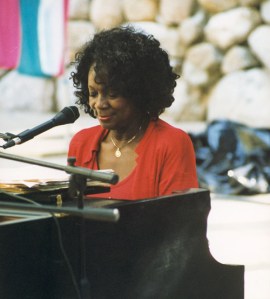 Legendary blues pianist and vocalist Jeannie Cheatham (84) was the first woman to induct anyone into the Smithsonian Jazz Hall of Fame. Her friend pianist Dorothy Donegan was that musician. Cheatham said it’s a choice to be a musician. “Professional musicians, men and women must be conscientious about their decision to live that lifestyle. They must promote, book, schedule, rehearse, do the accounting and take responsibility for their career,” said Cheatham. Each member of Cheatham’s Sweet Baby Blues Band had their own band and worked with musicians they liked. Cheatham worked with trumpeter Clora Bryant fromTexas, saxophonist Vi Redd inLos Angeles and drummer Patty Patton inSan Diego, where she resides.
Besides being co-leader with her husband Jimmy Cheatham of Ellington Band fame, Jeannie accompanied Cab Calloway, whose sister Blanche had her own big band in the early 20th century. “Sidemen want to be called, hired, have fun and go home,” said Cheatham. “Agents may like to book all-female bands. But most touring bands don’t hire women because of rooming arrangements. It’s easier to sleep four men to a room. A woman means an extra room,” said Cheatham, who believes women have it much easier, today. “When I was young, a woman had to put a man’s name on her music to get it played.” Cheatham insisted that women who choose to be professional musicians must work just as hard as men and have equal success, if they apply themselves.
For Kim Clarke, “women musicians must be tenacious and cultivate a following, unless they’re with a major record company that builds their fan base.” Men have no problem being sidemen but women must have what Clarkes calls, “The look – the right age and the right size.” If she’s not good looking, she accepts gigs men won’t take or she’s a Diva, throwing her weight around.” Clarke said gay women work more often in the gay arena. Clarke worked with Kit McClure in a wedding band for several years, until McClure tired of that kind of gig. Also, Clarke works with Bertha Hope on piano and Paula Hampton on drums in “Jazzberry Jam, a dynamic group whose spectacular ability to communicate with each other produces the best in musical improvisation, and informs the audience of their humor and humanity.” Clarke said, “Grace Kelly is a Korean alto saxophonist whose father owns a candy factory. Grace works the big festivals because her father pays to promote her. But without a sponsor, most female musicians are on their own, and club owners are about the money. You must hustle to get people interested in your music.”

Vocalist and composer Beverly Lewis lives inItalyand said, “You don’t find female musicians on the level we have here.” She said there are no female drummers in Italy because “there are no drumming schools in Europe, except in Amsterdam and at the Swiss Jazz School in Berne, Switzerland. Women drummers are rare and in such demand that they usually work with famous singers, making them unavailable for gigs with local artists. The biggest problem for Lewis is that “musicians are not acting out of authenticity but out of a program. They will go where the money is rather than be loyal to a musical genre.” However, drummer Terri Lyne Carrington is a professor at Berklee College of Music inBostonand Cindy Blackman Santana is at the top of the charts in the jazz world, along with Brazilian bassist Esperanza Spaulding.
In New York City, where pay-to-play is policy, women musicians stay away. Cheatham said musicians must meet people and let other musicians and club owners know they are musicians. “If you’re not willing to socialize, you won’t work,” she insisted.

When pianist/vocalist LaVelle lived inParis, she was grossly under-appreciated. In Switzerland, she’s a big fish in a little pond. She performs in Russia, France, Switzerland and other European countries with organist Rhoda Scott. The two make a dynamic duo and enjoy working with each other.
Online social media helps musicians expose their music to a wider audience. Facebook, Twitter, MySpace, CDBaby, YouTube, iTunes and Reverbnation are sites for music promotion. The world consists of men and women. So, the jazz scene should consist of men and women. However, women are left out so often that it is “normal” to omit them. What are some of the reasons women musicians are overlooked?
Women don’t get to work in ensemble as men do, so their “chops” are weaker. They are soloists because they only get to play solo. Women’s menstrual cycle results in mood shifts, body pains and ailments that make them irritable. They may be untrusting, insecure, critical and selfish, wanting to be the headliner rather than accompany a singer or horn player, while males don’t mind being sidemen. Women don’t support each other the way men do. Men are better team players. This is based on the fact that, in secondary school and college, boys work with each other in sports, while girls learn run households, where they are in charge. Boys engage in teamwork, while girls learn to clean, cooking and sew, all solitary endeavors.
Dr. Malcolm Black, 20-year big band leader at Broward College said girls who play instruments in middle and high school drop music in college because “their priorities change to fashion, romance and other studies. This is proliferated by the belief that music is traditionally a male field. Lugging a saxophone or contrabass is a male thing and doesn’t fit in with the girl’s outfit,” said Black. Bassist Kim Clarke said, “It’s fashionable to wear make-up, weaves, high heels, short skirts and hate on other women. And it’s boys versus music. If her boyfriend is insecure and doesn’t like her in the band with other boys, she drops the instrument, abandoning music. Women quit sooner than men, if they feel threatened by competition.”
Recently retired vocal instructor Lorna Lesperance said, “Girls take up an instrument at performing arts schools to get credit for that class. But they’re interested in singing, dancing or theater. Once the class is finished, they forget about the instrument.”
Peer pressure dictates that, if a girl’s friends are not interested in music, she discontinues music studies to be with her friends, even if she has talent. Parents, teachers and community mentors must encourage girls to stick with music and groom them for music careers. Girls must transcend the stigma that musicians are not respected like teachers, nurses, doctors, lawyers, accountants, engineers and other professionals. Although most musicians study from an early age, they are said to be playing. Parents don’t encourage children to be musicians, fearing they won’t be able to provide for themselves and their families in the future. Other deterrents in the music industry are drug abuse and alcoholism, especially in Jazz and Rock.
But women musicians excel and are leaders in their own right.
- Junior Mance said, “Melba Liston is one of the best jazz musicians, not just one of the best women in jazz.”
- Pianist, composer and educator Gerald Price said, “Organist Trudy Pitts handled herself formidably in an arena of musicians made up mostly of men.”
- Pianist Tania Maria “The Lady from Brazil” was an attorney in her homeland. She suffered from omission in that field to the point that she leftBraziland came to theUnited States, where she pursued a musical career that brought her great notoriety.
If there is no female bassist, pianist or drummer, a band leader can invite a woman to join as a singer, percussionist or woodwind player. Since women pay taxes, it’s only fair that women are represented, globally, on the Jazz Scene, especially when bands are funded through federal, state and local grants. Wanda Wright, President of Bethune Cookman’s Alumni Marching Band said, “People just don’t want to change the all male tradition of the marching band.” Perhaps, that’s across the board. But, in this high-tech world, where information is disseminated, rapidly, inequities like this can be rectified, rapidly. For five years, our grant awards have funded concerts, featuring women musicians at least twice a year. We engage students and adults to perform original compositions of members of both genders.
Joan Cartwright, Founder/Executive Director
WOMEN IN JAZZ SOUTH FLORIDA, INC.
www.wijsf.org
 musicwomanarchive.com
Pingback: WIJSF Newsletter May 2012 | Women in Jazz South Florida, Inc.
Pingback: WIJSF MARCH 2016 NEWSLETTER | tcecksteinvocalese1